





By using our website, you agree to the use of cookies as described in our Cookie Policy
Ready to apply for business funding?
Start our simple online application now.


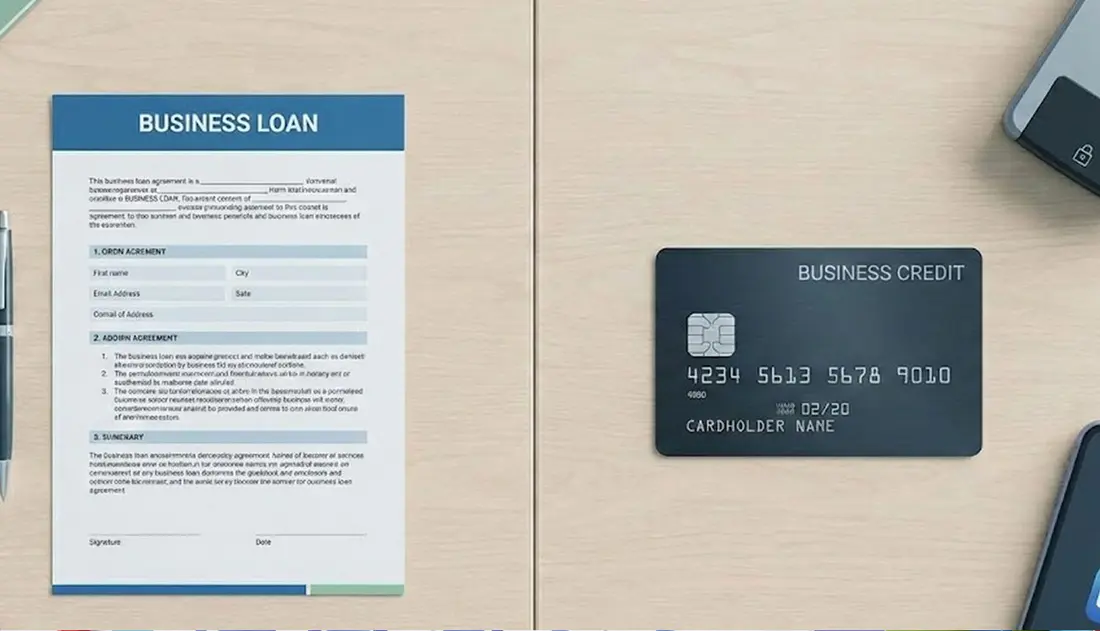
You need funding for your business. A credit card seems easy. A loan seems more serious. Which one actually makes sense for your situation?
The answer depends on how much you need, what you're using it for, and how quickly you can pay it back. Business loans work better for larger amounts and defined purchases.
Credit cards offer flexibility for ongoing smaller expenses. Understanding the differences helps you choose the option that costs less and fits your actual needs.
Business loans and credit cards are fundamentally different products, even though both provide access to capital.
Business loans give you a lump sum upfront that you repay over a fixed term with interest. You know exactly what you owe, what your payments are, and when you'll be done. Once you repay the loan, it's closed.
Business credit cards provide a revolving credit line. You can borrow up to your limit, pay it down, and borrow again. There's no fixed end date. The balance can stay open indefinitely as long as you make minimum payments.
According to a 2025 Federal Reserve's report, 53% of employer firms used or carried a balance on business loans on a regular basis, and 34% of employer firms used lines of credit.
Business loans are typically the better choice in certain situations.
Large, defined expenses. If you need $50,000 for equipment or $100,000 for expansion, a credit card isn't practical. Business loans handle larger amounts with structured repayment that matches the investment's useful life.
Lower interest costs on bigger balances. Business loan rates, particularly from banks and SBA lenders, often run 7% to 15% for qualified borrowers. Credit card rates typically range from 18% to 26%. On a $50,000 balance, that difference costs thousands of dollars annually.
Predictable monthly payments. Loan payments are fixed. You know exactly what you owe each month, making budgeting straightforward. Credit card payments fluctuate with your balance and can creep up if you're not careful.
Building toward a specific goal. Opening a new location, buying a vehicle, funding a major project. These defined uses with clear timelines suit loan structures well.
Longer repayment needs. Long-term loans can stretch five, ten, or even twenty-five years for SBA products. Credit cards expect faster repayment, and carrying balances long-term gets expensive.

See How Much Capital Your Business Can Access & Start Growing Today!
Apply NowCredit cards work better in other situations.
Smaller, ongoing expenses. Office supplies, subscriptions, travel costs, minor equipment. For purchases under a few thousand dollars that happen regularly, credit cards are more convenient than repeatedly applying for loans.
Cash flow smoothing. Charging expenses now and paying when revenue arrives helps manage timing gaps. A credit card used this way and paid off monthly costs nothing in interest.
Rewards and perks. Business credit cards offer cash back, travel points, or other rewards. If you're paying the balance monthly, you're essentially getting paid to use the card. Loans don't offer rewards.
Emergency backup. Having available credit for unexpected small expenses provides peace of mind. A credit card sitting in your wallet costs nothing until you use it.
Building credit history. Responsible credit card use builds your business credit profile over time. A strong credit history improves your options for future financing.
Uncertain funding needs. If you don't know exactly how much you'll need or when, a credit card's flexibility beats a loan's fixed amount. A business line of credit offers similar flexibility with potentially better rates.
The true cost of financing depends on how much you borrow, what rate you pay, and how long you carry the balance.
Credit card example: You charge $20,000 at 22% APR and make minimum payments. After three years, you'll have paid roughly $8,000 in interest, and you'll still owe a balance. Minimum payments are designed to keep you in debt.
Business loan example: You borrow $20,000 at 12% APR with a three-year term. Fixed monthly payments of about $664 pay off the loan completely, with total interest around $3,900.
The loan costs less than half as much for the same amount borrowed over the same period.
But change the scenario. If you charge $5,000 and pay it off within 60 days, the credit card costs almost nothing. Short-term use with quick payoff is where credit cards shine.
The rule of thumb: For amounts you'll carry more than a few months, loans usually cost less. For amounts you'll pay off quickly, credit cards work fine and offer more convenience.
Credit cards and loans serve different scales of funding needs.
Business credit cards typically offer limits ranging from $5,000 to $50,000 for most small businesses. Established businesses with strong credit might access higher limits, but six-figure credit card lines are uncommon.
Business loans range much wider. Short-term loans start around $5,000 and can reach $500,000. SBA loans go up to $5 million. If you need more than $50,000, loans are usually your only realistic option.
Getting approved for each product involves different requirements.
Credit cards are generally easier to obtain. Many business credit cards approve applicants with personal credit scores in the mid-600s. Newer businesses can often qualify. The application process is quick, sometimes with instant decisions.
Business loans typically have stricter requirements. Banks want credit scores of 680 or higher and at least two years in business. Online lenders are more flexible, with some working with scores as low as 500 and businesses operating just six months. But loan applications involve more documentation and take longer to process.
If your credit is challenged, our guide on bad credit business loans covers your options.
Both products affect your credit, but differently.
Credit cards impact your credit utilization ratio. Using more than 30% of your available credit can lower your score. Keeping balances low relative to limits helps your score. Payment history matters significantly.
Business loans add to your total debt but don't affect utilization ratios the same way. On-time payments build positive credit history. The loan appearing on your credit report isn't inherently negative if you're managing it responsibly.
For building business credit specifically, having both a business credit card with responsible use and a business loan with on-time payments creates a stronger profile than either alone.
Many businesses use credit cards and loans for different purposes. This isn't either/or.
A typical approach might include a term loan for major equipment, a line of credit for working capital needs, and a credit card for day-to-day expenses and travel. Each product handles what it does best.
The key is matching the tool to the task. Don't put $75,000 of equipment on a credit card. Don't take out a loan for $2,000 in office supplies. Use each product where it makes sense.
Is it better to use a business loan or credit card for startup costs?
It depends on the amount. For costs under $10,000 that you can repay within a few months, a credit card may work. For larger startup investments, a loan provides more capital at lower rates. Many startups use both: loans for major expenses, cards for smaller ongoing costs.
Can I use a business credit card like a loan?
Technically yes, but it's usually expensive. Carrying large balances long-term on a credit card costs significantly more than a comparable loan. Credit cards work best for short-term borrowing you repay quickly.
Do business credit cards require a personal guarantee?
Most do, especially for small businesses. Your personal credit is checked, and you're personally liable for the balance if the business can't pay. This is similar to most small business loans, which also typically require personal guarantees.
Which builds business credit faster?
Both can build business credit if the issuer or lender reports to business credit bureaus. Having a mix of credit types, including revolving credit like cards and installment credit like loans, generally builds a stronger profile than either alone.
What if I need more than my credit card limit?
That's when loans become necessary. If your funding need exceeds your available credit card limit, a business loan, line of credit, or other financing product can provide the larger amount you require.


Sign up for our newsletter to get exclusive updates and offers

Start our simple online application now.

See what our clients have to say about their experience with us.

© 2026 BusinessCapital, LLC
